


Complete Guide to Dental Instruments: Types, Uses, Surgical Instruments, Materials & Buying Guide (2026)

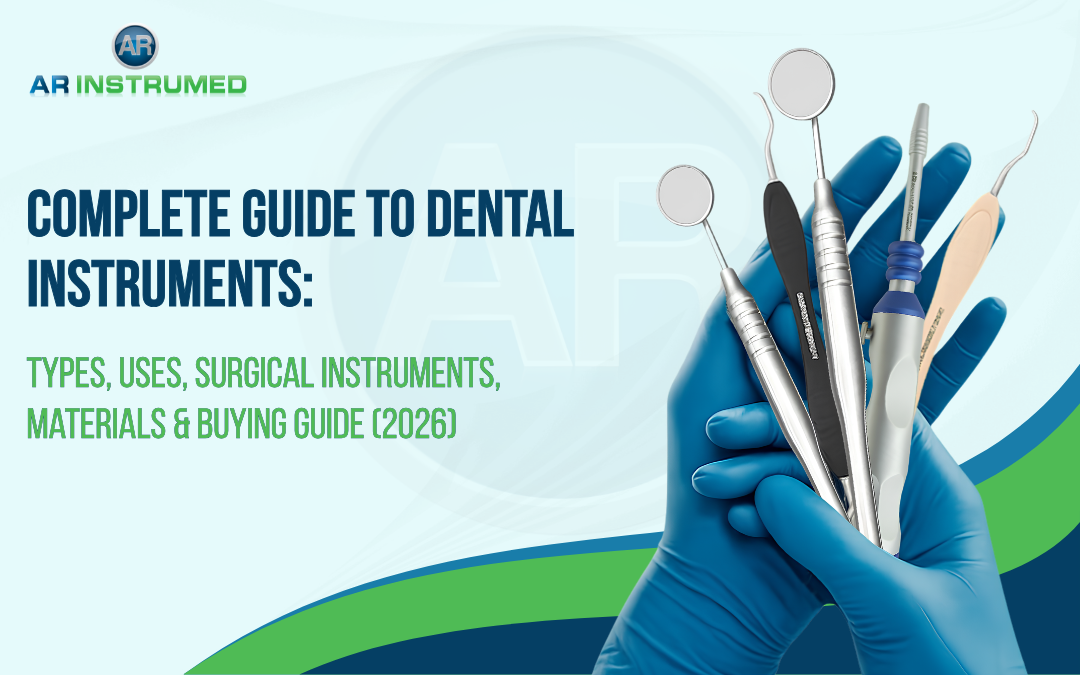
If you walk into any dental clinic in Karachi, Lahore, or Islamabad, the first thing you notice on the tray is a neat row of shiny steel tools. Those tools are not just “equipment” they are the reason a dentist can diagnose a cavity, remove a tooth painlessly, or perform a complex oral surgery with confidence. This guide breaks down everything you need to know about dental instruments in 2026: their types, their uses, the materials they are made from, and how to choose the right supplier or manufacturer for your clinic, hospital, or export business in Pakistan.
Whether you are a dental student trying to learn instrument names, a clinic owner building your first tray setup, or a distributor looking for a trusted dental instrument manufacturer, this dental instruments guide is written to answer your real questions in one place.
Dental instruments are the specialized hand tools and surgical devices dentists, oral surgeons, and hygienists use to examine, treat, and operate on teeth, gums, and the surrounding oral structures. Every dental tools tray is built around three goals: accurate diagnosis, safe treatment, and patient comfort.
A poorly made or worn-out instrument can slow down a procedure, cause discomfort, or even compromise sterilization. That is why understanding instrument quality is just as important as understanding instrument function, especially for clinics that handle a high patient volume.
Types of Dental Instruments Every Dental Professional Should Know
There are dozens of types of dental instruments, but most fall into five broad categories based on their clinical purpose.
1. Examination Instruments
These are the first tools used in almost every checkup. Mouth mirrors help dentists see areas that are hard to view directly, while dental probes and explorers are used to detect cavities, check gum pockets, and feel for rough or decayed surfaces.
2. Restorative Instruments
Restorative instruments are used for fillings and repairs. Amalgam carriers, plastic filling instruments, and burnishers help dentists shape and place filling material precisely so the restoration matches the natural tooth structure.
3. Extraction Instruments
Extraction instruments, including dental forceps and elevators, are designed to loosen and remove teeth with minimal trauma to the surrounding bone and tissue. Different forceps are shaped for upper, lower, front, and back teeth.
4. Periodontal Instruments
Scalers and curettes fall under this category and are used to remove plaque, tartar, and calculus from teeth and below the gumline, which is essential for preventing gum disease.
5. Orthodontic Instruments
Pliers, wire cutters, and band pushers are used to place, adjust, and remove braces and other orthodontic appliances, giving orthodontists the control needed for precise wire bending.
Dental Surgical Instruments: Precision Tools for Oral Surgery
Dental surgical instruments are a more advanced category used for procedures like impacted tooth removal, implant placement, and minor oral surgeries. This group typically includes scalpel handles, needle holders, tissue retractors, bone rongeurs, and surgical curettes.
Because surgical instruments come into direct contact with bone and deep tissue, they must be made from surgical-grade stainless steel and manufactured to strict tolerances. A single misaligned tip on a needle holder or forceps can affect suturing accuracy during surgery, which is why hospitals and clinics should always source these tools from a certified dental instrument manufacturer.
Common Dental Instrument Names and Their Uses
New dental students often struggle to memorize instrument names. Here is a quick reference list of some of the most common dental instrument names used daily in clinics:
- Mouth Mirror – used for indirect vision and retraction of cheeks or tongue
- Explorer (Probe) – used to detect caries and check restoration margins
- Periodontal Probe – used to measure gum pocket depth
- Scaler – used to remove plaque and tartar
- Curette – used for subgingival scaling and root planing
- Extraction Forceps – used to grip and remove teeth
- Elevator – used to loosen teeth before extraction
- Needle Holder – used to hold suture needles during surgery
Knowing these dental instrument uses helps both dental students and clinic staff organize their trays correctly for each procedure.
Materials Used in Dental Instrument Manufacturing
Material quality is one of the biggest factors separating a reliable instrument from a cheap one. Most professional dental tools are manufactured using German or Japanese-grade stainless steel, which offers strong resistance to corrosion and repeated autoclave sterilization.
Some specialized instruments, particularly implant and micro-surgical tools, use titanium because it is lightweight, non-magnetic, and highly biocompatible. When comparing suppliers, always check the steel grade mentioned in the product specification, since this directly affects how long an instrument stays sharp and rust-free.
Dental Instrument Buying Guide: What to Check Before You Purchase
If you are building or upgrading a clinic, this simple dental instrument buying guide can save you from costly mistakes:
- Check the steel grade and finish (matte or mirror-polish) for durability
- Look for CE and ISO certification on surgical and restorative instruments
- Ask whether instruments are autoclavable and rust-resistant
- Compare pricing for bulk orders if you are a distributor or hospital
- Choose a supplier who offers customization and private labeling
Buying from a trusted dental instrument supplier not only ensures better clinical outcomes but also reduces the long-term cost of replacing damaged tools.
Pakistan’s dental and surgical instrument export industry, centered largely around Sialkot, has grown into a globally recognized manufacturing hub. AR Instrumed is one of the manufacturers working within this industry, producing dental and surgical instruments for clinics, hospitals, and international distributors.
You can explore their product range, request a catalog, or check manufacturing details directly on the AR Instrumed website. For clinics and buyers in Pakistan looking for a dependable dental instrument manufacturer and supplier, it is worth reviewing their catalog before placing a bulk order.
Conclusion
Dental instruments are far more than metal tools on a tray they directly influence diagnosis accuracy, treatment quality, and patient comfort. Whether you are a dentist selecting instruments for your own practice or a distributor sourcing in bulk, understanding instrument types, uses, and materials helps you make smarter buying decisions. For clinics and businesses in Pakistan researching a dependable dental instrument manufacturer, exploring a catalog like the one on the AR Instrumed website is a good next step before placing an order.
Frequently Asked Questions
1. What are the most commonly used dental instruments in a clinic?
The most frequently used dental instruments include the mouth mirror, explorer, periodontal probe, scaler, and curette, since these are needed in nearly every routine checkup.
2. What is the difference between dental instruments and dental surgical instruments?
General dental instruments are used for examination and basic treatment, while dental surgical instruments, such as scalpel handles and needle holders, are used specifically for surgical procedures like extractions and implants.
3. What material is best for dental instruments?
High-grade stainless steel is the industry standard because it resists corrosion and withstands repeated autoclave sterilization, while titanium is preferred for lightweight, non-magnetic surgical tools.
4. How do I choose a reliable dental instrument supplier in Pakistan?
Look for CE and ISO certification, check the steel grade used, ask for sample orders before bulk purchase, and review the supplier’s export experience and customer feedback.
5. How often should dental instruments be replaced?
Instruments should be replaced when they show signs of corrosion, dullness, or misalignment, which typically happens after months to a few years of use depending on sterilization frequency and handling.