


Conservative Dental Instruments: Types, Uses & How to Choose the Right Instruments

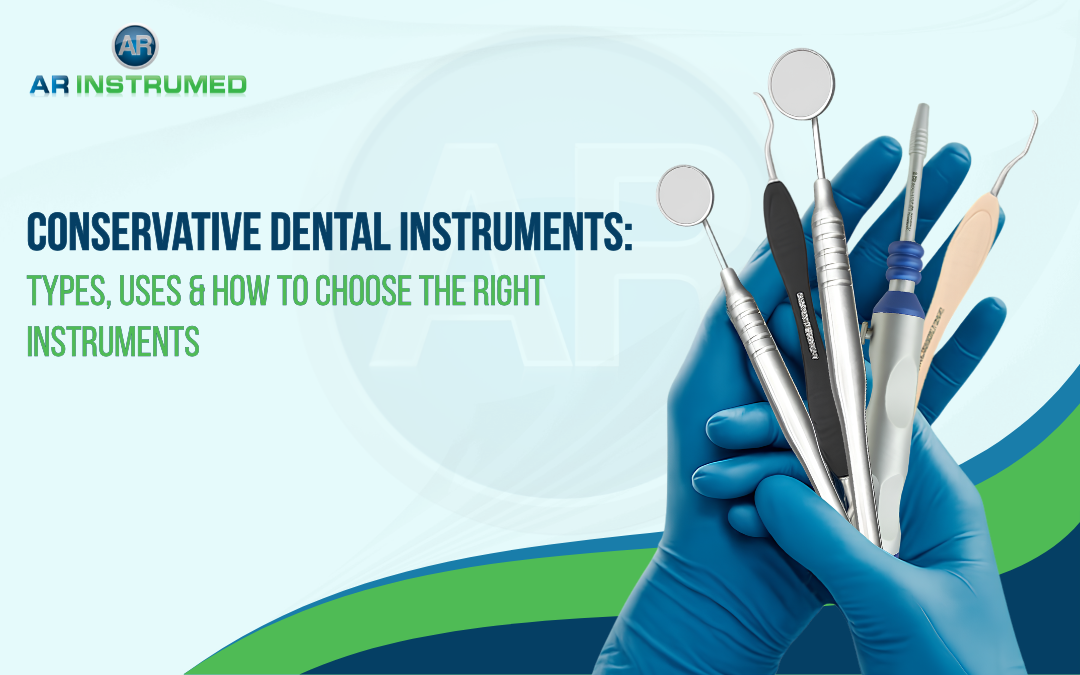
Conservative dental instruments are the hand tools dentists rely on to shape, place, and finish restorations while preserving as much healthy tooth structure as possible. They sit at the core of everyday operative dentistry, from a routine composite filling to a more complex restorative case.
This guide explains what conservative dental instruments are, the main categories every clinic should know, and the practical factors that matter when selecting or sourcing them. It's written for dentists, dental students, clinics, and the distributors and wholesalers who supply them including buyers evaluating AR Instrumed as a manufacturer and supplier of dental instruments.
What Are Conservative Dental Instruments?
Conservative dental instruments are hand instruments used in conservative (operative) and restorative dentistry to prepare, place, shape, and finish dental restorations. The goal of conservative dentistry is to treat decay or damage while removing the minimum amount of healthy tooth structure necessary and the instruments used reflect that precision-first approach.
These instruments generally fall into a few functional groups: instruments that remove decayed material, instruments that carry and place restorative material, instruments that shape and burnish that material, and instruments that mix it beforehand. Together, they form the core hand-instrument kit for conservative dental instruments used across general dentistry, restorative dentistry, and dental education.
Main Types of Conservative Dental Instruments
While a full operative kit can include many specialized tools, four categories form the backbone of most conservative and restorative procedures: burnishers, excavators, filling instruments, and spatulas.
Dental Burnishers
Dental burnishers are used to smooth, contour, and adapt restorative material — particularly amalgam and, in some techniques, the margins of other restorations. A ball burnisher, for example, is commonly used to condense and shape material against cavity walls and refine the surface before it sets.
Tip design matters a great deal here. Different burnisher shapes (ball, football, beaver-tail, and others) suit different anatomical contours and clinical steps, so having a range of tip geometries allows a dentist to adapt to the specific restoration being placed. When selecting dental burnishers, professionals should look at tip finish, consistency of shape across a set, and how comfortably the handle sits during repeated, controlled strokes.
Dental Excavators
Dental excavators are used primarily to remove carious (decayed) dentin and debris from a cavity preparation before restoration. Because the goal is to remove only compromised tissue, precision and control are essential — an excavator with a dull or inconsistent edge makes it harder to distinguish sound tooth structure from decay by feel.
Spoon-shaped excavators are among the most widely used designs, available in different sizes and angulations for anterior and posterior access. When evaluating a dental excavator, clinicians typically consider blade sharpness, edge consistency, and how well the instrument reaches into smaller or awkward cavity preparations.
Dental Filling Instruments
Filling instruments are used to carry, place, and condense restorative material into a prepared cavity. They play a direct role in how well a restoration is adapted to the cavity walls and margins, which affects both the seating of the material and the finishing steps that follow.
Handling characteristics matter as much as the working tip. An instrument that holds material cleanly without excessive sticking, and that gives the operator tactile feedback during placement, supports a more controlled restoration process. Buyers sourcing dental filling instruments should look closely at tip design, balance, and consistency across a full set, since mismatched instruments can slow down a procedure.
Dental Spatulas
Dental spatulas are used mainly for mixing restorative and cementing materials, though some designs also assist with placement and initial shaping. A dental cement spatula, for instance, needs a blade that mixes powder-liquid or paste materials evenly without excessive material loss, along with a handle that’s comfortable for repeated mixing motions.
Blade flexibility, width, and edge design all affect how efficiently a material can be mixed to a workable consistency. Clinics and labs sourcing dental spatulas generally look for a design that suits their most commonly used materials, whether that’s cement, impression material, or restorative compounds.
How to Choose the Right Conservative Dental Instruments
Choosing conservative dental instruments is less about picking a single “best” product and more about matching instrument design to clinical need. A few practical factors make the biggest difference:
- Intended clinical application — anterior vs. posterior work, the material being used, and the specific procedural step all influence which tip shapes and sizes are appropriate.
- Tip shape and size — a well-matched tip reduces chair time and improves control, particularly for excavators and burnishers.
- Handle design and ergonomics — instruments used for extended or repetitive procedures should feel balanced and comfortable to reduce operator fatigue.
- Precision and edge/tip consistency — especially important for excavators, where tactile feedback depends on a reliable edge.
- Material quality and durability — instruments should hold their shape and finish through repeated clinical use and sterilization cycles.
- Sterilization compatibility — instruments need to withstand standard autoclave sterilization without corrosion or degradation over time.
- Consistency across a set — when instruments in a kit vary in weight, balance, or finish, it disrupts workflow; consistency across a full set matters for clinical efficiency.
- Supplier reliability and availability — for clinics and distributors alike, being able to reorder matching instruments consistently is often as important as the initial purchase.
For clinics buying in smaller quantities and distributors or wholesalers buying in bulk, these considerations apply similarly the difference is usually scale and the need for dependable supply over time.
Why Quality Matters When Buying Dental Instruments
Instrument quality directly affects clinical outcomes and day-to-day efficiency. A precisely finished excavator or burnisher gives clearer tactile feedback, which supports more controlled, predictable procedures. Instruments made with attention to material selection and finishing also tend to hold up better through repeated sterilization cycles, which matters for both clinical safety and long-term value.
Beyond the clinical side, quality builds professional confidence. Dentists and staff who trust their instruments can focus on the procedure rather than compensating for inconsistent tools. This is one reason instrument quality and supplier reputation are closely linked — a manufacturer that maintains consistent quality control tends to produce instruments that behave predictably, set after set.
Choosing a Dental Instrument Manufacturer or Supplier
For clinics, dental supply companies, and distributors, choosing where to source conservative dental instruments is a commercial decision as much as a clinical one. Useful factors to evaluate include:
- Product range — does the supplier offer a full set of conservative and restorative instruments, or only a narrow selection?
- Manufacturing capability and quality control — consistent finishing and material selection across production runs.
- Customization options — some buyers require specific tip variations, markings, or packaging.
- Bulk order capacity — relevant for distributors, wholesalers, and dental supply companies placing larger or recurring orders.
- Distributor and dealer support — clear communication, responsive order handling, and consistent supply.
- International supply experience — important for buyers outside the manufacturer’s home market.
- Communication and responsiveness — a supplier that answers technical and commercial questions clearly is easier to build a long-term relationship with.
AR Instrumed manufactures and supplies professional dental instruments, including conservative and restorative instrument categories, for dental clinics, distributors, wholesalers, importers, and dental supply companies both in Pakistan and internationally. Buyers evaluating a manufacturer or supplier relationship are welcome to explore the product range directly.
Explore Conservative Dental Instruments from AR Instrumed
AR Instrumed offers a range of conservative dental instruments, including:
- Dental burnisher instruments for shaping and finishing restorations
- Dental excavators for cavity preparation
- Dental filling instruments for restorative placement
- Restorative dental spatulas for mixing and handling materials
Dental clinics can browse the categories above to find instruments suited to their procedures. Distributors, wholesalers, and dental supply companies interested in bulk or recurring supply are welcome to reach out through dealer and bulk-order inquiries.
Get in Touch
Whether you're a dentist evaluating instruments for your clinic, a dental student building a foundational kit, or a distributor or importer looking for a manufacturing partner, AR Instrumed is available to answer product and supply questions for buyers in Pakistan and internationally. Visit the AR Instrumed homepage to explore the full product catalog, or contact AR Instrumed directly to discuss product details, bulk requirements, or dealer opportunities.
Frequently Asked Questions
What are conservative dental instruments?
Conservative dental instruments are hand tools used in operative and restorative dentistry to prepare, place, shape, and finish dental restorations while preserving as much healthy tooth structure as possible.
What instruments are commonly used in conservative dentistry?
Common categories include excavators for removing decay, filling instruments for placing restorative material, burnishers for shaping and finishing, and spatulas for mixing materials.
What are dental burnishers used for?
Burnishers are used to smooth, contour, and adapt restorative material against cavity walls, and to refine surfaces and margins before the material sets.
What are dental excavators used for?
Excavators remove carious (decayed) dentin and debris from a cavity preparation, allowing the clinician to isolate sound tooth structure before restoration.
How do I choose conservative dental instruments?
Consider the clinical application, tip shape and size, handle ergonomics, material quality, sterilization compatibility, and consistency across the full instrument set.
What should I look for in a dental instrument supplier?
Look for a broad, relevant product range, consistent quality control, bulk order capability, reliable communication, and experience supplying international buyers if you’re sourcing across borders.
Where can I buy conservative dental instruments?
Clinics and distributors can source conservative dental instruments directly from manufacturers such as AR Instrumed, or through authorized dental supply distributors, depending on order volume and regional requirements.